

Low Water Levels on the Rhine and Danube: How the Drought Is Weighing on the European Economy
This summer, Europe is experiencing historically low water levels on two of its most important rivers: the Rhine and the Danube. The consequences are severe—not only for the environment, but above all for the European economy. Inland waterway transport, a central pillar of logistics in Germany, Romania, and other riparian countries, is on the verge of collapse. At the same time, the energy supply in Central Europe is coming under pressure, as power plants rely on cooling water.
But what does this mean, specifically, for businesses, supply chains, and consumers? And how can those affected prepare for a future with more frequent extreme weather events? A recent Coface study takes a closer look at these questions.
Current Situation: An Overview of Records and Facts
The situation is dire—the numbers speak for themselves:
- On August 18, 2026, the water level of the Rhine near Kaub dropped to just 8 centimeters—well below the 78-cm mark at which navigation is restricted. The previous low record was 25 cm (2018).
- In early August, inland waterway vessels on the Rhine were carrying only one-fifth of their usual cargo volume.
- The Rhine (60%) and the Danube (12%) account for 72% of European inland waterway traffic.
- In 2018, low water levels reduced German GDP growth by 0.3 to 0.4 percentage points.
Logistics Crisis: Why Freight Transport on the Rhine and the Danube Is Systemically Important
Although inland waterway transport accounts for only a small portion of European freight transport, it is indispensable for some countries. In Germany, inland waterway transport accounts for 5.4% of freight transport, while in Romania the figure is as high as 19.2%. 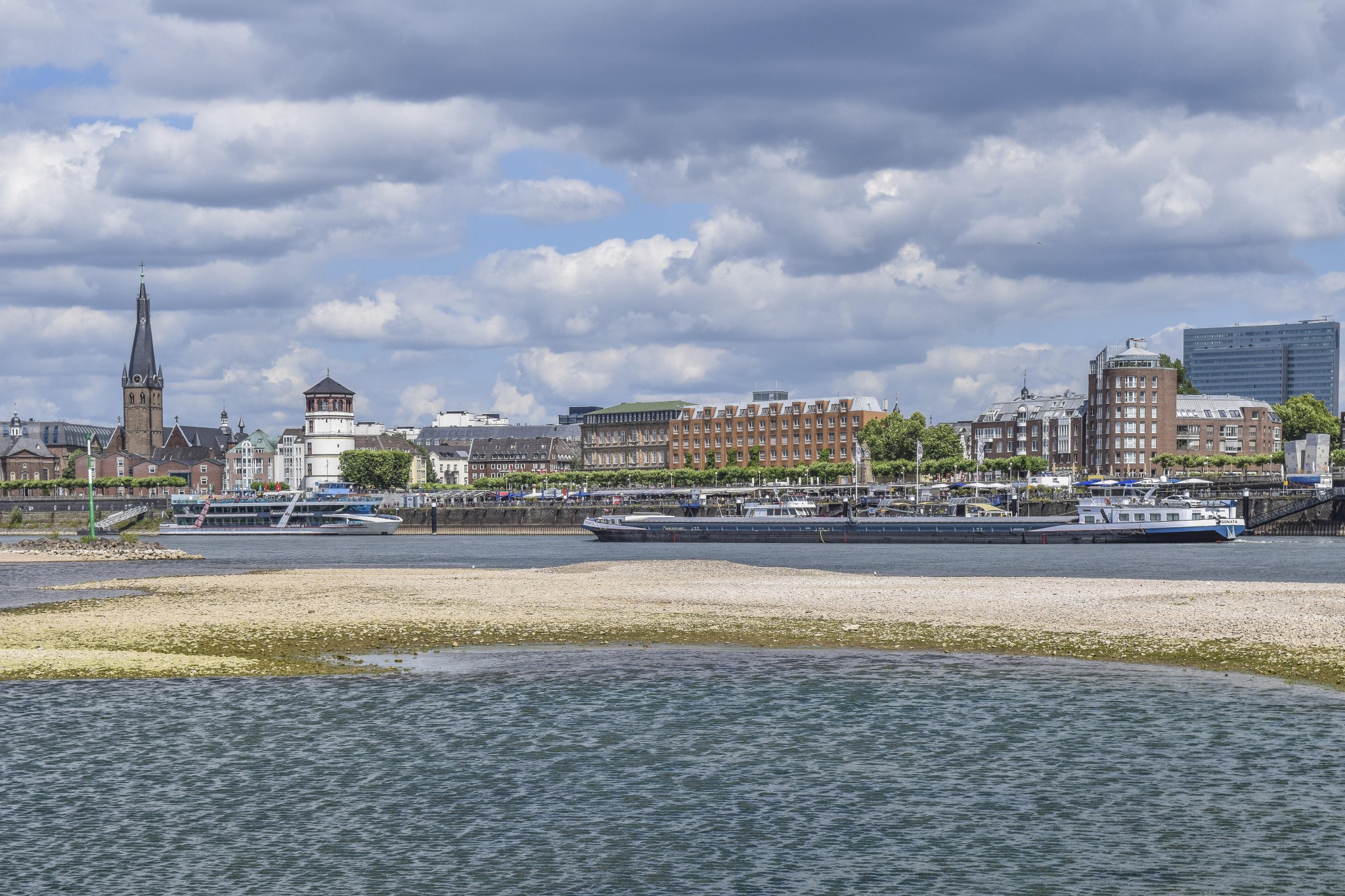 The problem is that there are no easy alternatives. An inland waterway vessel can carry up to 2,000 metric tons, while a freight train can carry only 1,500 metric tons and a tanker truck just 25 metric tons. Switching to other modes of transport is therefore virtually impossible—and extremely expensive. In 2018, the costs for dry bulk cargo rose 2.5-fold, and for liquid cargo, they rose as much as 4.5-fold.
The Energy Sector Under Pressure: How the Danube Is Threatening the Power Supply
The Danube is not only an important transportation route but also a lifeline for cooling nuclear power plants in Hungary and Romania. In Hungary, the Paks Nuclear Power Plant accounts for 40% of the country’s electricity generation, while in Romania, the Cernavodă Nuclear Power Plant accounts for 20.5% of electricity generation.
The consequences of the low-water period are manifold. First, power plants must reduce their output, which leads to a decline in production. Second, electricity imported from abroad costs 2 to 2.5 times as much in Romania as domestically generated electricity. Third, the governments in Hungary and Romania have already called on industrial consumers—such as the automotive, chemical, and building materials industries—to reduce their consumption.
The German chemical industry: A sector particularly hard-hit
Germany’s chemical industry is heavily dependent on the Rhine—especially the BASF site in Ludwigshafen:
- 40% of freight is transported via the Rhine.
- If water levels continue to drop, there is a risk of disruptions to supply chains to the ports of Amsterdam, Rotterdam, and Antwerp.
- The industry is already struggling with high energy costs and has seen a 20% drop in production since 2018.
Long-Term Risks: Climate Change Is Making Extreme Weather the New Normal
The current drought is not an isolated incident. Experts warn that more frequent heat waves and melting glaciers will make periods of low water more common and more severe. The low-water season typically lasts into the fall, and there is no sign of improvement in the short term.
It is clear what companies need to do now. First, they should push ahead with diversifying their supply chains to reduce their dependence on inland waterway transport. Second, they must integrate climate risks into their strategy and develop contingency plans for recurring extreme weather events. Third, they should improve energy efficiency and explore alternatives to water-dependent power generation.
“Low water levels on the Rhine and Danube show that extreme weather is no longer just an environmental problem. It is becoming an economic factor that affects logistics, energy, and industry all at once.”
– Eve Barré, economist at Coface
Conclusion: A Call to Action for Politicians and the Business Community
The current crisis reveals just how vulnerable the European economy is to climate risks. While short-term stopgap measures such as electricity imports or changes in transportation modes are necessary, structural adjustments must be considered for the long term. Investments in climate-resilient infrastructure, the expansion of alternative transportation modes such as rail and road, and an energy policy that takes extreme weather into account are key measures in this regard.
The question is no longer whether the next drought is coming, but when it will come—and how well Europe is prepared for it.